Sports Analytics — NFL Receiving (Super Bowl LIX)
Help motivated readers research Sports → NFL → Receiving and turn public box scores + gamebooks into insights. Focus game: Chiefs vs Eagles, Feb 9, 2025.
Receiving Performance & Distribution
We study how targets/yards concentrate (star-driven) or spread (balanced), then connect it to practical takeaways. Sources combine a standard box score (ESPN), a historical/stat archive (Pro-Football-Reference), and the NFL’s official gamebook.
Super Bowl LIX: What the tables show — and why it matters

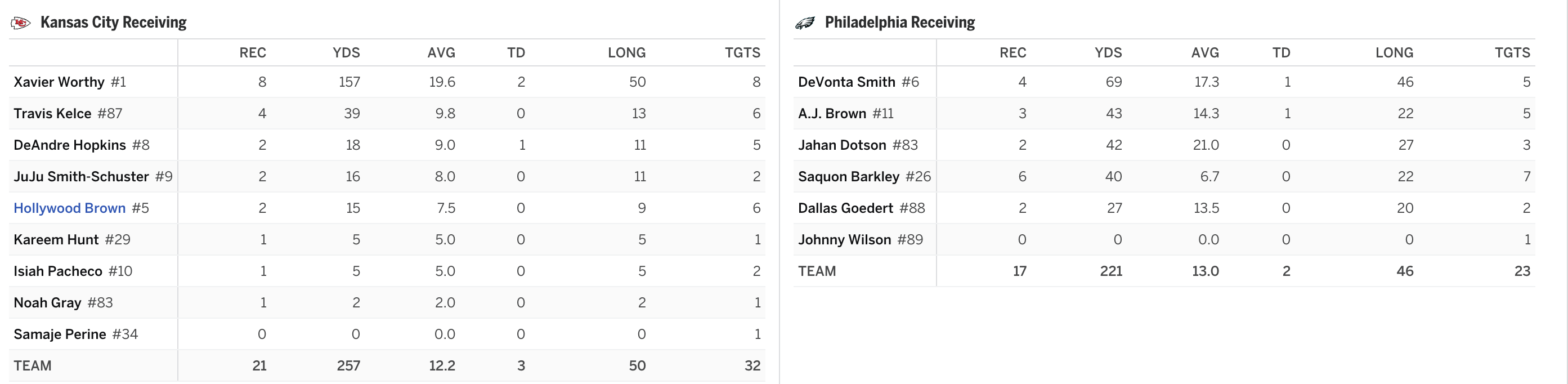
1) Concentration vs. balance (ESPN box): Kansas City’s rookie WR Xavier Worthy posted 157 receiving yards. Mahomes threw for 257 yards, so Worthy accounted for ~61% of KC’s receiving (157 ÷ 257). That’s a classic star-centric profile. Philadelphia’s leader DeVonta Smith had 69 of 221 pass yards (~31%) — a more balanced distribution.
What this means: Star-centric attacks can be explosive yet brittle if the defense brackets the No. 1 target. Balanced teams are harder to tilt because multiple options move the chains.

2) Cross-checking & per-play efficiency (PFR): Use PFR to verify receptions and yards and to compute simple efficiency. For example, Worthy’s yards per catch ≈ 19.6 (157 ÷ 8), while Smith’s ≈ 17.3 (69 ÷ 4). Per-catch explosiveness was high for both clubs, but only Philadelphia combined chunk plays with a broader distribution.

3) Drive context (NFL gamebook): The gamebook shows when/where explosive receptions occurred (e.g., Worthy’s late deep TDs vs. earlier drives). Tie those moments to the scoreboard flow to see whether yards arrived in catch-up scripts or within sustainable offense.
Three Data Sources (name, logo, page link, screenshot)

ESPN — Box Score (primary)
Landing page: Super Bowl LIX box score

Pro-Football-Reference — Game Page
Landing page: Chiefs at Eagles — Feb 9, 2025

NFL — Official Gamebook (PDF)
Landing page: Super Bowl LIX gamebook
Insights & Goals a Consumer Might Have
- Identify offensive identity: Compute top-receiver share of team pass yards. KC ≈ 61% star-centric; PHI ≈ 31% balanced.
- Explosiveness vs. consistency: Compare yards per catch for top threats; then scan gamebook to see if gains came in late/garbage time vs. early success.
- Defensive planning: For KC, expect brackets on Worthy; for PHI, defenses must cover multiple outlets (Smith/Brown/TE) rather than one bracket.
Sample Analysis: Replicating the Insight
- Open ESPN box → note total pass yards (KC 257, PHI 221) and each leader’s yards (Worthy 157, Smith 69), then compute shares.
- Open PFR → confirm receptions to compute yards per catch (Worthy 157/8 ≈ 19.6; Smith 69/4 ≈ 17.3) and scan other receivers to judge balance.
- Open NFL gamebook → locate drives containing Worthy’s TDs; note game state (score/time). If most yards are late while trailing, that supports “catch-up explosiveness.”
- Synthesize → Star-centric KC produced chunk plays but lacked breadth; PHI paired explosive shots with distribution, which is harder to choke off.